Unleashing Potential: Boosting physical activity in children with developmental disabilities via a family-dog-assisted intervention.

Darling, S., Wanser, S.H., Jiang, D., Schuna, J. M., Udell, M.A.R, MacDonald,M. (2024). Unleashing potential: Boosting physical activity in children with developmental disabilities via a family-dog-assisted intervention. Human-Animal Interactions. https://www.cabidigitallibrary.org/doi/10.1079/hai.2024.0009

Abstract: In the context of a global crisis, where over 80% of children fail to meet minimum standards of physical activity, children with developmental disabilities may face an even greater health disparity. Despite being disproportionately less physically active than the broader population, those with developmental disabilities are often excluded from mainstream interventions. This study evaluated a novel animal-assisted intervention (AAI) that incorporated the family pet dog, with the goal of increasing physical activity in children with developmental disabilities. The intervention involved teaching child participants to engage in “Do as I Do” (DAID) reciprocal-imitation training with their dog over ten 60-min sessions. After enrollment, 45 child-dog pairs of children and their family dogs were randomly assigned to either the experimental intervention (DAID) group, the active control group (dog walking control [DWC]), or the passive control group (waitlist control [WC]). Physical activity was measured using a 7-day ActiGraph accelerometer monitoring process, and data were analyzed for children who wore the accelerometer for a minimum of 4 days at both assessment time points (N = 14). Participation in the intervention (DAID) group was found to significantly increase moderate-to-vigorous physical activity (MVPA) by 1.2 min/h (p = 0.0087; Cohen’s d = 1.7) and significantly reduce sedentary behavior by 4.03 min/h (p = 0.027; d = 1.3), outperforming the waitlist control group. Our findings demonstrate the potential of this novel dog-assisted intervention to improve physical activity in this population, thereby contributing to a reduction in health disparities.
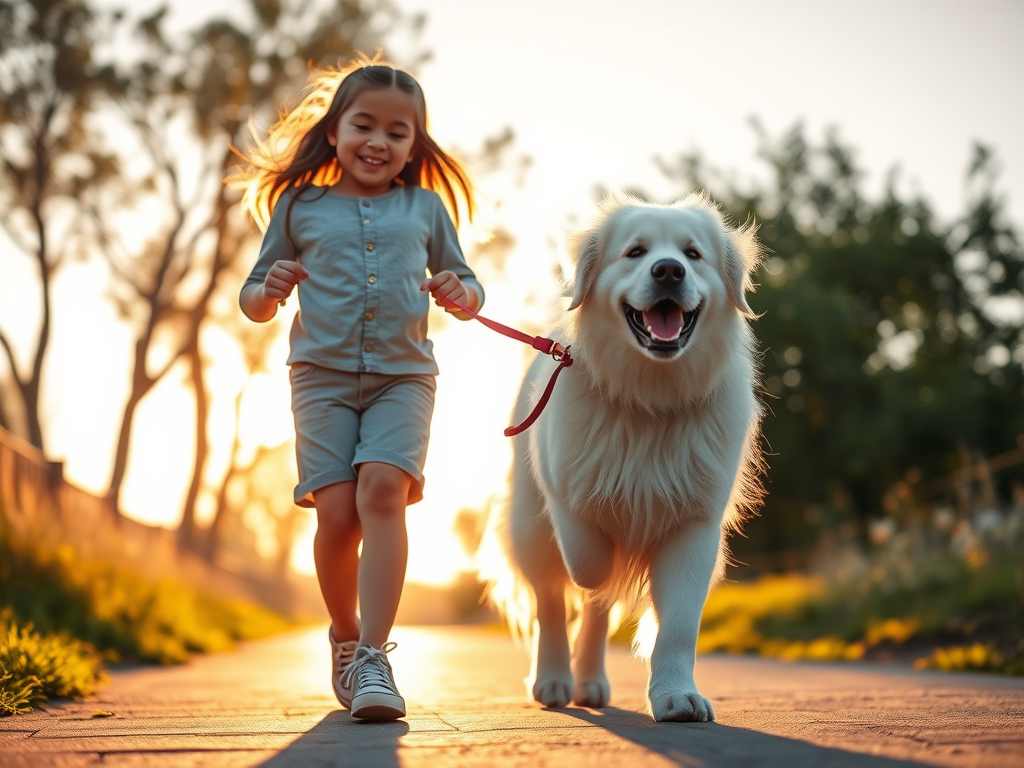
Happy child walking her Great Pyrenees dog on a leash outdoors

Effects of a Brief Separation From the Owner While in the Home Environment: Comparison of Fearful and Control Dogs

Bentosela, M., Cavalli, C., Dzik, M. V., Caliva, M., & Udell, M. A. R. (2024). Effects of a Brief Separation From the Owner While in the Home Environment: Comparison of Fearful and Control Dogs. Anthrozoös37(5), 959–975. https://doi.org/10.1080/08927936.2024.2389643

Abstract: Separation from their owner is stressful for some dogs. Studies examining this phenomenon are usually carried out in novel places. However, given that separation distress can also impact the behavior and welfare of dogs in their home environment, it is critical to study them in this context as well. Our first aim was to evaluate the reactions of dogs to a brief separation from their owner in the home. Secondly, we aimed to examine differences in the reactions of dogs classified as fearful, without (n = 27) and with (n = 17) aggressive responses, as well as controls (n = 28). All dogs were adults, from various breeds and mixes, and lived as pets. Each dog’s behavior was evaluated across three phases: (1) 2 min interaction with owner (baseline), (2) 3 min separation from the owner (alone), and (3) 2 min after the owner returned (owner return). We measured exploration as well as affiliative and stress behaviors. The results show that dogs explored the environment more in phase 1, directed more behaviors toward the door through which the owner had left in phase 2, followed the owner leaving at the end of phase 2, and greeted them when they returned in phase 3. Dogs also spent more time near the owner after their absence in phase 3 than in phase 1. A decrease in exploration triggered by the absence of the owner in phase 2 and a lack of full exploration recovery in phase 3 were observed as possible indicators of stress. No differences were found between fearful dogs and controls. The results indicate that it is possible to evaluate dogs’ reactions to separation from their owner in a more naturalistic context. This could aid in the development of strategies to improve separation-related problems in dogs and thus improve their welfare and quality of life.