Effects of a Brief Separation From the Owner While in the Home Environment: Comparison of Fearful and Control Dogs

Bentosela, M., Cavalli, C., Dzik, M. V., Caliva, M., & Udell, M. A. R. (2024). Effects of a Brief Separation From the Owner While in the Home Environment: Comparison of Fearful and Control Dogs. Anthrozoös37(5), 959–975. https://doi.org/10.1080/08927936.2024.2389643

Abstract: Separation from their owner is stressful for some dogs. Studies examining this phenomenon are usually carried out in novel places. However, given that separation distress can also impact the behavior and welfare of dogs in their home environment, it is critical to study them in this context as well. Our first aim was to evaluate the reactions of dogs to a brief separation from their owner in the home. Secondly, we aimed to examine differences in the reactions of dogs classified as fearful, without (n = 27) and with (n = 17) aggressive responses, as well as controls (n = 28). All dogs were adults, from various breeds and mixes, and lived as pets. Each dog’s behavior was evaluated across three phases: (1) 2 min interaction with owner (baseline), (2) 3 min separation from the owner (alone), and (3) 2 min after the owner returned (owner return). We measured exploration as well as affiliative and stress behaviors. The results show that dogs explored the environment more in phase 1, directed more behaviors toward the door through which the owner had left in phase 2, followed the owner leaving at the end of phase 2, and greeted them when they returned in phase 3. Dogs also spent more time near the owner after their absence in phase 3 than in phase 1. A decrease in exploration triggered by the absence of the owner in phase 2 and a lack of full exploration recovery in phase 3 were observed as possible indicators of stress. No differences were found between fearful dogs and controls. The results indicate that it is possible to evaluate dogs’ reactions to separation from their owner in a more naturalistic context. This could aid in the development of strategies to improve separation-related problems in dogs and thus improve their welfare and quality of life.
Does attachment security to a human handler influence the behavior of dogs who engage in animal assisted activities?

Wanser, S.H., Udell, M.A.R. (2018) Does attachment security to a human handler influence the behavior of dogs who engage in animal assisted activities? Applied Animal Behaviour Science DOI: https://doi.org/10.1016/j.applanim.2018.09.005 
Abstract

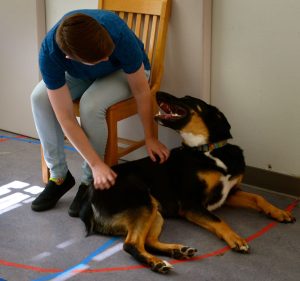
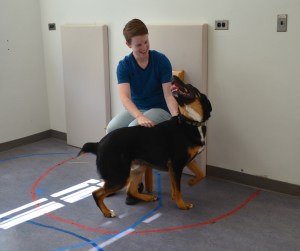
Pet and working dogs raised with humans are known to form attachments to their caregivers and other humans with whom they have a stable relationship. Attachment style varies across dog-human dyads, with securely attached dogs exhibiting the secure base effect, an ability to find comfort in the presence of an attachment figure in unusual situations, allowing for greater exploration. The secure base effect is also known to facilitate interactions with unfamiliar individuals. Dogs who engage in Animal Assisted Activities (AAA) are often asked to engage with unfamiliar people in unfamiliar environments, therefore it is possible that dogs with a secure attachment to their human handlers may be more prepared for success in this role. This study evaluated the behavior of 16 dogs who engage in AAA. Using a secure base test dogs were categorized as demonstrating secure (exhibiting the secure base effect with their owner/handler; n = 8) or insecure (not exhibiting the secure base effect; n = 8) attachment styles toward their handlers. Later the dyads participated in a mock animal assisted activity session to evaluate their working behavior. Our findings indicate that independent of attachment style, dogs who engage in AAA spent significantly more time in proximity to, and touching, the AAA participant than their handler (p < 0.001 for both proximity and touch). However, on average the AAA dogs spent significantly more time gazing at their handler than at the participant during the session (p = 0.03). Dogs with an insecure attachment style appear to have driven this effect as evidenced by a non-significant trend suggesting that they gazed longer at their handlers than at the participant (p = 0.07), whereas secure dogs did not display the same trend (p = 0.24). This could suggest that while their training mandates proximity and interaction with unfamiliar people, dogs who engage in AAA may be using gaze to maintain contact with their handlers, especially in the absence of a secure attachment where prolonged comfort seeking from the attachment figure would be expected.

Highlights

  • Overall, dogs with secure or insecure attachment behave similarly in AAA setting.
  • Trend suggests AAA dogs with insecure attachment may gaze at handler more.
  • Gaze may be a contact maintaining behavior when physical proximity is not possible.
  • Gazing may provide insight into motivation and coping of dogs in AAA setting.

Structural variants in genes associated with human Williams-Beuren syndrome underlie stereotypical hypersociability in domestic dogs

(2017) Structural variants in genes associated with human Williams-Beuren syndrome underlie stereotypical hypersociability in domestic dogs. Science Advances. DOI: 10.1126/sciadv.1700398

Abstract

Although considerable progress has been made in understanding the genetic basis of morphologic traits (for example, body size and coat color) in dogs and wolves, the genetic basis of their behavioral divergence is poorly understood. An integrative approach using both behavioral and genetic data is required to understand the molecular underpinnings of the various behavioral characteristics associated with domestication. We analyze a 5-Mb genomic region on chromosome 6 previously found to be under positive selection in domestic dog breeds. Deletion of this region in humans is linked to Williams-Beuren syndrome (WBS), a multisystem congenital disorder characterized by hypersocial behavior. We associate quantitative data on behavioral phenotypes symptomatic of WBS in humans with structural changes in the WBS locus in dogs. We find that hypersociability, a central feature of WBS, is also a core element of domestication that distinguishes dogs from wolves. We provide evidence that structural variants in GTF2I and GTF2IRD1, genes previously implicated in the behavioral phenotype of patients with WBS and contained within the WBS locus, contribute to extreme sociability in dogs. This finding suggests that there are commonalities in the genetic architecture of WBS and canine tameness and that directional selection may have targeted a unique set of linked behavioral genes of large phenotypic effect, allowing for rapid behavioral divergence of dogs and wolves, facilitating coexistence with humans.