 Brubaker, L. Dasgupta, S., Bhattacharjee, D., Bhadra, A., Udell, M. (2017) Differences in problem-solving between canid populations: Do domestication and lifetime experience affect persistence? Animal Cognition. DOI: 10.1007/s10071-017-1093-7
Abstract
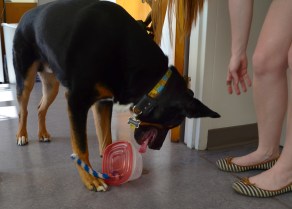
Past research has suggested that a variety of factors, phylogenetic and ontogenetic, play a role in how canines behave during problem-solving tasks and the degree to which the presence of a human influences their problem-solving behaviour. While comparisons between socialized wolves and domestic dogs have commonly been used to tease apart these predictive factors, in many cases a single dog population, often pets, have been used for these comparisons. Less is understood about how different populations of dogs may behave when compared with wolves, or with each other, during an independent problem-solving task. This experiment compared the independent persistence of four populations of canines (two groups of pet domestic dogs, a group of free-ranging domestic dogs, and human-socialized wolves) on an independent problem-solving task in the presence of an on looking human. Results showed that wolves persisted the most at the task while free-ranging dogs persisted the least. Free-ranging dogs gazed at the human experimenter for the longest durations during the task. While further research is needed to understand why these differences exist, this study demonstrates that dogs, even those living outside human homes as scavengers, show comparatively low levels of persistence when confronted with a solvable task in the presence of a human as well as significantly greater duration of human-directed gaze when compared with wolves.
 Udell, MAR, Brubaker, L. (2016) Are Dogs Social Generalists? Canine Social Cognition, Attachment, and the Dog-Human Bond. Current Directions in Psychological Science.