CATastrophic myths part 1: Common misconceptions about the social behavior of domestic cats and implications for their health, welfare, and management

Croney, C., Udell, M. A. R., Delgado, M., Ekenstedt, K. J., Shoveller, A.K. (2023). CATastrophic Myths Part 1: Common misconceptions about the social behavior of domestic cats and implications for their health, welfare, and management. The Veterinary Journal. https://doi.org/10.1016/j.tvjl.2023.106028

Abstract: Cats are among the most popular pets worldwide, but there are still major gaps in the public’s general understanding of their social behaviors and related needs, including for socialization. In addition to these knowledge gaps, people often have negative or ambivalent attitudes about cats, which can directly impact their welfare outcomes. Insufficient attention to the behavioral ecology and development of cat sociality, along with failure to account for their highly variable individual preferences and tolerance for social behaviors can lead them to experience distress that undermines both their welfare and the human-animal bond. As Part 1 of a two-part series addressing common myths about cats, the purpose of this first paper is to review and debunk common misperceptions about the social needs and behaviors of cats, including misunderstandings about their social lives and abilities to bond with humans. We also identify where opportunities exist to improve socialization of cats and to advance research in related areas that might better support their behavior and welfare needs.
Attachment bonds between domestic cats and humans

Vitale, K. R., Behnke, A. C., & Udell, M. A. R. (2019). Attachment bonds between domestic cats and humans. Current Biology, 29(18), R864–R865.  DOI:  https://doi.org/10.1016/j.cub.2019.08.036


FULL TEXT AVAILABLE FOR DOWNLOAD AT THIS LINK


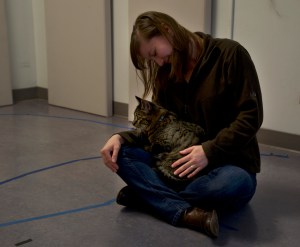
Cat displaying secure attachment

Cat displaying insecure-avoidant attachment

Cat displaying insecure-ambivalent attachment

The quality of being sociable: The influence of human attentional state, population, & human familiarity on domestic cat sociability

Vitale, KR, & Udell, MAR. (2019) The quality of being sociable: The influence of human attentional state, population, and human familiarity on domestic cat sociability. Behavioural Processes: 158, 11-17. DOI: https://doi.org/10.1016/j.beproc.2018.10.026 


Link to publication 

Abstract

Two experiments were conducted to assess the influence of human attentional state, population, and human familiarity on domestic cat sociability. Sociability behaviors included duration of time in proximity and contact with the human and the frequency of meow vocalizations. Human attentional state influenced cat behavior, with cats spending significantly more time in proximity with the attentive human in both the pet (U(22) = 389, Z = -2.72, P = 0.007) and shelter groups (F(44) = 15.34, P = 0.0003). Cat population influenced sociability and shelter cats spent more time in proximity with the inattentive unfamiliar human as compared to pet cats (U(44) = 91, Z = 3.8, P = 0.0001) Additionally compared to pet cats, more individuals in the shelter cat group meowed at least once during the unfamiliar human inattentive phase (Fisher’s exact test, P = 0.02). Human familiarity did not significantly influence pet cat sociability behaviors. Overall, a wide range of sociability scores was seen, indicating individual variation is an important consideration in cat social behavior. Future research in this area will predict conditions under which strong cat-human bonds form and establish a more comprehensive scientific understanding of cat behavior.

Highlights

  • Relatively little scientific research has been conducted on cat-human social behavior.
  • Cats are facultatively social animals that display flexibility in social behavior.
  • Human attentional state and cat population influenced cat sociability behaviors.
  • Human familiarity did not influence pet cat sociability behaviors.
  • Clear individual variation in sociability scores was noted.