Attachment bonds between domestic cats and humans

Vitale, K. R., Behnke, A. C., & Udell, M. A. R. (2019). Attachment bonds between domestic cats and humans. Current Biology, 29(18), R864–R865.  DOI:  https://doi.org/10.1016/j.cub.2019.08.036


FULL TEXT AVAILABLE FOR DOWNLOAD AT THIS LINK


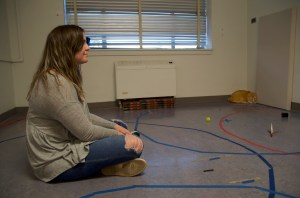
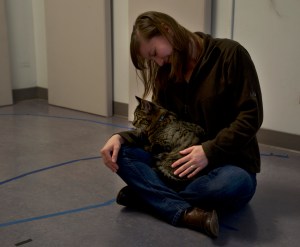
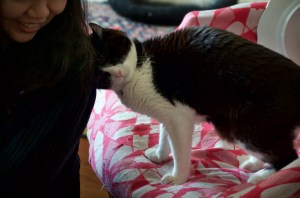
Cat displaying secure attachment

Cat displaying insecure-avoidant attachment

Cat displaying insecure-ambivalent attachment

The quality of being sociable: The influence of human attentional state, population, & human familiarity on domestic cat sociability

Vitale, KR, & Udell, MAR. (2019) The quality of being sociable: The influence of human attentional state, population, and human familiarity on domestic cat sociability. Behavioural Processes: 158, 11-17. DOI: https://doi.org/10.1016/j.beproc.2018.10.026 


Link to publication 

Abstract

Two experiments were conducted to assess the influence of human attentional state, population, and human familiarity on domestic cat sociability. Sociability behaviors included duration of time in proximity and contact with the human and the frequency of meow vocalizations. Human attentional state influenced cat behavior, with cats spending significantly more time in proximity with the attentive human in both the pet (U(22) = 389, Z = -2.72, P = 0.007) and shelter groups (F(44) = 15.34, P = 0.0003). Cat population influenced sociability and shelter cats spent more time in proximity with the inattentive unfamiliar human as compared to pet cats (U(44) = 91, Z = 3.8, P = 0.0001) Additionally compared to pet cats, more individuals in the shelter cat group meowed at least once during the unfamiliar human inattentive phase (Fisher’s exact test, P = 0.02). Human familiarity did not significantly influence pet cat sociability behaviors. Overall, a wide range of sociability scores was seen, indicating individual variation is an important consideration in cat social behavior. Future research in this area will predict conditions under which strong cat-human bonds form and establish a more comprehensive scientific understanding of cat behavior.

Highlights

  • Relatively little scientific research has been conducted on cat-human social behavior.
  • Cats are facultatively social animals that display flexibility in social behavior.
  • Human attentional state and cat population influenced cat sociability behaviors.
  • Human familiarity did not influence pet cat sociability behaviors.
  • Clear individual variation in sociability scores was noted.

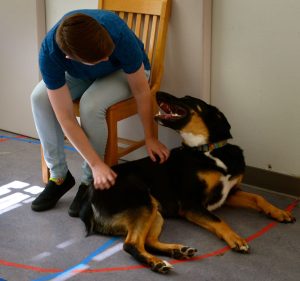
Does attachment security to a human handler influence the behavior of dogs who engage in animal assisted activities?

Wanser, S.H., Udell, M.A.R. (2018) Does attachment security to a human handler influence the behavior of dogs who engage in animal assisted activities? Applied Animal Behaviour Science DOI: https://doi.org/10.1016/j.applanim.2018.09.005 

Abstract

Pet and working dogs raised with humans are known to form attachments to their caregivers and other humans with whom they have a stable relationship. Attachment style varies across dog-human dyads, with securely attached dogs exhibiting the secure base effect, an ability to find comfort in the presence of an attachment figure in unusual situations, allowing for greater exploration. The secure base effect is also known to facilitate interactions with unfamiliar individuals. Dogs who engage in Animal Assisted Activities (AAA) are often asked to engage with unfamiliar people in unfamiliar environments, therefore it is possible that dogs with a secure attachment to their human handlers may be more prepared for success in this role. This study evaluated the behavior of 16 dogs who engage in AAA. Using a secure base test dogs were categorized as demonstrating secure (exhibiting the secure base effect with their owner/handler; n = 8) or insecure (not exhibiting the secure base effect; n = 8) attachment styles toward their handlers. Later the dyads participated in a mock animal assisted activity session to evaluate their working behavior. Our findings indicate that independent of attachment style, dogs who engage in AAA spent significantly more time in proximity to, and touching, the AAA participant than their handler (p < 0.001 for both proximity and touch). However, on average the AAA dogs spent significantly more time gazing at their handler than at the participant during the session (p = 0.03). Dogs with an insecure attachment style appear to have driven this effect as evidenced by a non-significant trend suggesting that they gazed longer at their handlers than at the participant (p = 0.07), whereas secure dogs did not display the same trend (p = 0.24). This could suggest that while their training mandates proximity and interaction with unfamiliar people, dogs who engage in AAA may be using gaze to maintain contact with their handlers, especially in the absence of a secure attachment where prolonged comfort seeking from the attachment figure would be expected.

Highlights

  • Overall, dogs with secure or insecure attachment behave similarly in AAA setting.
  • Trend suggests AAA dogs with insecure attachment may gaze at handler more.
  • Gaze may be a contact maintaining behavior when physical proximity is not possible.
  • Gazing may provide insight into motivation and coping of dogs in AAA setting.