Structural variants in genes associated with human Williams-Beuren syndrome underlie stereotypical hypersociability in domestic dogs

(2017) Structural variants in genes associated with human Williams-Beuren syndrome underlie stereotypical hypersociability in domestic dogs. Science Advances. DOI: 10.1126/sciadv.1700398

Abstract

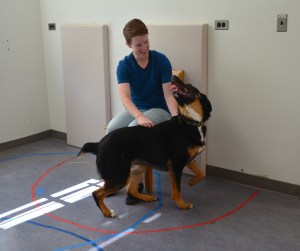
Although considerable progress has been made in understanding the genetic basis of morphologic traits (for example, body size and coat color) in dogs and wolves, the genetic basis of their behavioral divergence is poorly understood. An integrative approach using both behavioral and genetic data is required to understand the molecular underpinnings of the various behavioral characteristics associated with domestication. We analyze a 5-Mb genomic region on chromosome 6 previously found to be under positive selection in domestic dog breeds. Deletion of this region in humans is linked to Williams-Beuren syndrome (WBS), a multisystem congenital disorder characterized by hypersocial behavior. We associate quantitative data on behavioral phenotypes symptomatic of WBS in humans with structural changes in the WBS locus in dogs. We find that hypersociability, a central feature of WBS, is also a core element of domestication that distinguishes dogs from wolves. We provide evidence that structural variants in GTF2I and GTF2IRD1, genes previously implicated in the behavioral phenotype of patients with WBS and contained within the WBS locus, contribute to extreme sociability in dogs. This finding suggests that there are commonalities in the genetic architecture of WBS and canine tameness and that directional selection may have targeted a unique set of linked behavioral genes of large phenotypic effect, allowing for rapid behavioral divergence of dogs and wolves, facilitating coexistence with humans.
Differences in problem-solving between canid populations: Do domestication and lifetime experience affect persistence?

Brubaker, L. Dasgupta, S., Bhattacharjee, D., Bhadra, A., Udell, M. (2017) Differences in problem-solving between canid populations: Do domestication and lifetime experience affect persistence? Animal Cognition. DOI: 10.1007/s10071-017-1093-7
Abstract

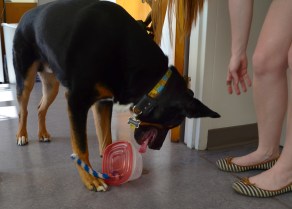
Past research has suggested that a variety of factors, phylogenetic and ontogenetic, play a role in how canines behave during problem-solving tasks and the degree to which the presence of a human influences their problem-solving behaviour. While comparisons between socialized wolves and domestic dogs have commonly been used to tease apart these predictive factors, in many cases a single dog population, often pets, have been used for these comparisons. Less is understood about how different populations of dogs may behave when compared with wolves, or with each other, during an independent problem-solving task. This experiment compared the independent persistence of four populations of canines (two groups of pet domestic dogs, a group of free-ranging domestic dogs, and human-socialized wolves) on an independent problem-solving task in the presence of an on looking human. Results showed that wolves persisted the most at the task while free-ranging dogs persisted the least. Free-ranging dogs gazed at the human experimenter for the longest durations during the task. While further research is needed to understand why these differences exist, this study demonstrates that dogs, even those living outside human homes as scavengers, show comparatively low levels of persistence when confronted with a solvable task in the presence of a human as well as significantly greater duration of human-directed gaze when compared with wolves.

Social interaction, food, scent or toys? A formal assessment of domestic pet and shelter cat preferences

Vitale Shreve, KR,  Mehrkam, LR, Udell, MAR. (2017) Social interaction, food, scent or toys? A formal assessment of domestic pet and shelter cat (Felis silvestris catus) preferences. Behavioural Processes. https://doi.org/10.1016/j.beproc.2017.03.016

Link to publication

Abstract

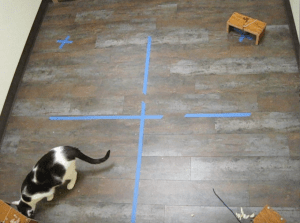
Domestic cats (Felis silvestris catus) engage in a variety of relationships with humans and can be conditioned to engage in numerous behaviors using Pavlovian and operant methods Increasingly cat cognition research is providing evidence of their complex socio-cognitive and problem solving abilities. Nonetheless, it is still common belief that cats are not especially sociable or trainable. This disconnect may be due, in part, to a lack of knowledge of what stimuli cats prefer, and thus may be most motivated to work for. The current study investigated domestic cat preferences at the individual and population level using a free operant preference assessment. Adult cats from two populations (pet and shelter) were presented with three stimuli within each of the following four categories: human social interaction, food, toy, and scent. Proportion of time interacting with each stimulus was recorded. The single most-preferred stimulus from each of the four categories were simultaneously presented in a final session to determine each cat’s most-preferred stimulus overall. Although there was clear individual variability in cat preference, social interaction with humans was the most-preferred stimulus category for the majority of cats, followed by food. This was true for cats in both the pet and shelter population. Future research can examine the use of preferred stimuli as enrichment in applied settings and assess individual cats’ motivation to work for their most-preferred stimulus as a measure of reinforcer efficacy.